
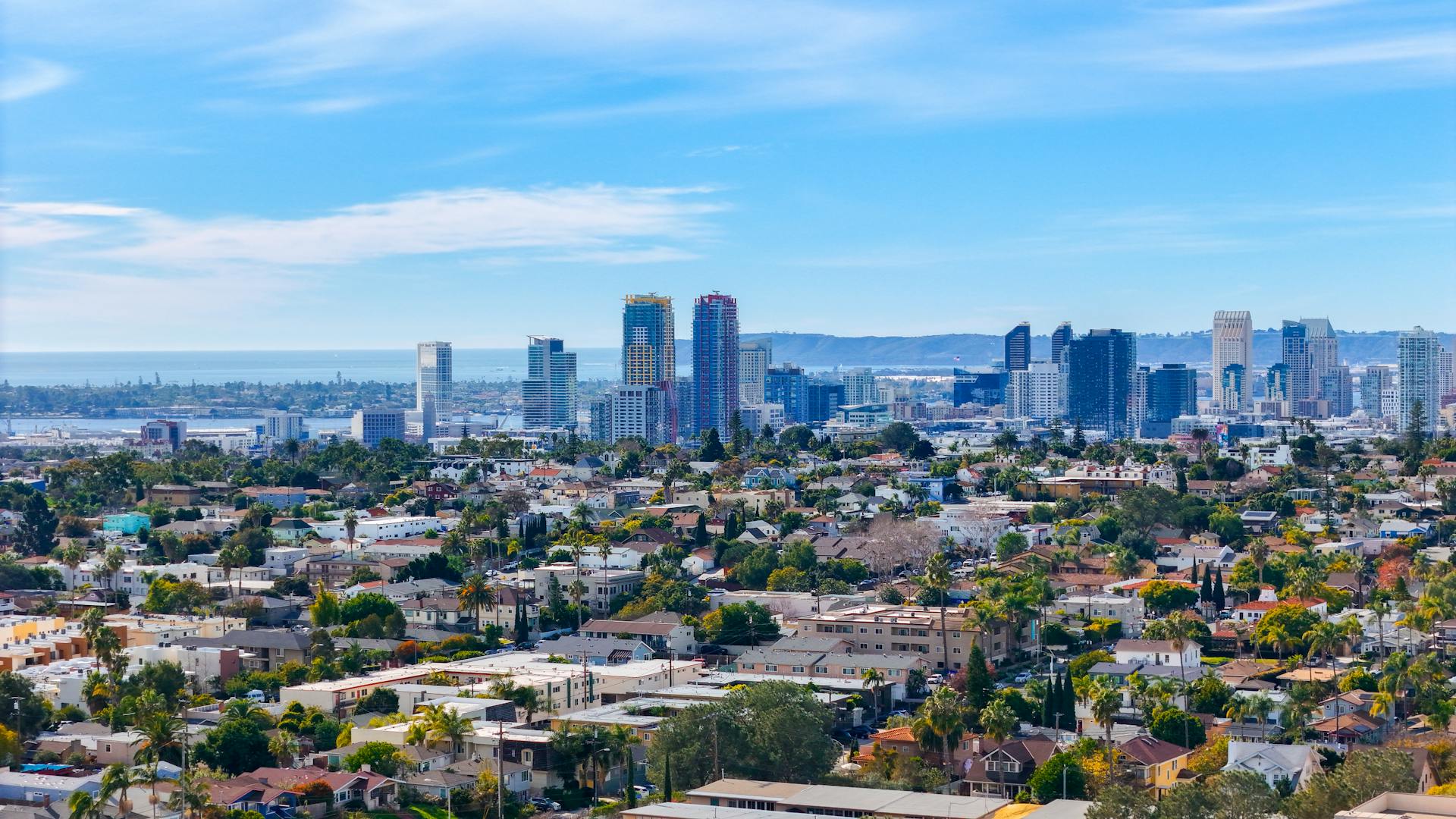
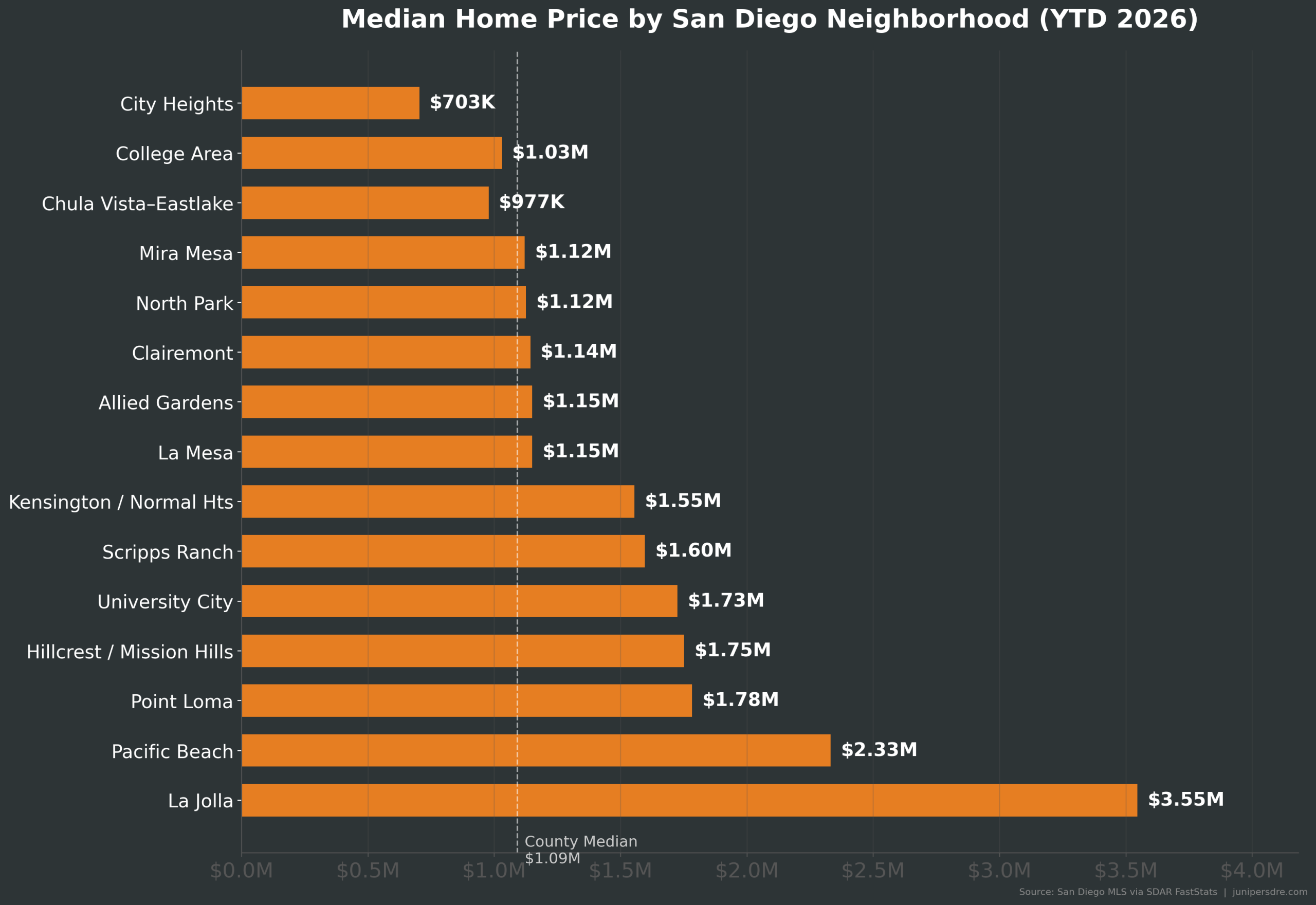
The best neighborhoods in San Diego depend entirely on what you’re looking for. The county-wide median home price sits at $1,089,795 for a single-family home and $660,000 for a condo, but those numbers hide enormous range. A house in City Heights costs $703,000. In La Jolla, you’re looking at $3.5 million. Same city, completely different markets.
Most “best neighborhoods” lists rank by vibes. We ranked by data. Using actual MLS transaction records from the San Diego Association of REALTORS and building permit data from the City of San Diego, we compared 15 neighborhoods across price, appreciation, days on market, inventory, and development activity. Whether you’re a first-time buyer, a family looking for schools, or an investor chasing rental yield, the numbers tell a clear story.
How We Ranked These Neighborhoods
Every neighborhood in this guide was evaluated on five data dimensions:
Median sale price: what homes actually sold for year-to-date in 2026, sourced from the San Diego MLS via SDAR FastStats. We used YTD figures rather than single-month medians to avoid small-sample distortion.
Price trend: year-over-year appreciation or decline. Rising prices signal demand. Falling prices signal opportunity.
Days on market: how quickly homes sell. Shorter DOM means stronger buyer competition. Longer DOM means more negotiating room.
Months supply of inventory: the number of homes for sale divided by the monthly sales pace. Under 2.0 is a seller’s market. Over 4.0 is a buyer’s market.
Development momentum: building permits issued in the last 12 months, pulled from the City of San Diego’s public permit database. This includes new construction and ADU permits. Where builders are investing tells you where the market is heading.
The Best San Diego Neighborhoods at a Glance
Here’s how all 15 neighborhoods compare, sorted from most affordable to most expensive. Every metric is sourced from actual closed transactions in 2026.
| Neighborhood | Median Price | YoY | DOM | Supply | Permits | Best For |
|---|---|---|---|---|---|---|
| City Heights | $703K | -4.5% | 29 | 2.1 | 170 | Budget buyers, investors |
| Chula Vista – Eastlake | $977K | -11.2% | 35 | 1.9 | — | South county families |
| College Area | $1.03M | -1.9% | 46 | 1.0 | 105 | Up-and-coming, investors |
| Clairemont | $1.14M | -4.6% | 24 | 1.2 | 265 | ADU builders, central location |
| Mira Mesa | $1.12M | -0.4% | 43 | 1.8 | 94 | Value families |
| North Park | $1.13M | -4.9% | 30 | 2.0 | 259 | Young professionals, walkability |
| Allied Gardens / Del Cerro | $1.15M | +4.5% | 58 | 0.9 | 61 | Up-and-coming families |
| La Mesa / Mount Helix | $1.15M | +29.9% | 71 | 1.9 | — | East county families |
| Kensington / Normal Heights | $1.56M | +6.3% | 43 | 1.8 | 82 | Character, walkability |
| Scripps Ranch | $1.60M | -4.4% | 41 | 1.2 | 8 | Top schools, suburban |
| University City | $1.73M | +7.1% | 9 | 1.2 | 25 | UCSD families, appreciation |
| Hillcrest / Mission Hills | $1.75M | +7.4% | 38 | 2.2 | 156 | Urban lifestyle |
| Point Loma | $1.78M | -8.0% | 38 | 2.3 | 99 | Coastal character |
| Pacific Beach | $2.33M | +13.8% | 41 | 2.5 | 137 | Beach lifestyle, investors |
| La Jolla | $3.55M | -11.0% | 65 | 3.8 | 88 | Luxury, long-term hold |
Swipe to see all columns →
Data: Median prices are YTD 2026 from San Diego MLS via SDAR FastStats. DOM = days on market. Supply = months supply of inventory. Permits = new construction + ADU permits issued Mar 2025 to Mar 2026 from City of San Diego.
Best Neighborhoods for Families
If schools, safety, and space are the priority, three neighborhoods consistently deliver.
Scripps Ranch is the prototypical San Diego family neighborhood. The median home price sits at $1.6 million, and with just 1.2 months of supply, homes don’t last long. Sellers are getting 99.2% of asking price. The draw is Lake Miramar, highly-rated Scripps Ranch schools, and the kind of quiet, tree-lined streets that make weekend bike rides easy. For families who want suburban without sacrificing a reasonable commute, this is the benchmark.
Mira Mesa offers a different family value proposition. At $1.12 million, it’s one of the more accessible neighborhoods on this list, and the 3,091 total building permits issued in the last year make it the second most active construction zone in the city. That activity is producing newer homes, better infrastructure, and a neighborhood that’s actively upgrading. Good school access, large lot sizes, and proximity to the Sorrento Valley tech corridor round it out.
University City is the academic powerhouse. Median price is $1.73 million, but homes sell in just 9 days on average (the fastest of any neighborhood in this dataset) and at 103.5% of list price. Buyers are competing hard. UCSD proximity means strong schools, research hospital access, and a steady influx of professional families. Year-over-year appreciation of 7.1% confirms the demand signal.
Also worth considering: La Mesa offers east county family living at $1.15 million with a small-town downtown, and Chula Vista–Eastlake brings newer south county construction under $1 million.
Best Neighborhoods for Young Professionals
Walkability, culture, and an entry point that doesn’t require $2 million. These three deliver.
North Park is where the energy is. The median single-family home is $1.13 million, but condos offer entry closer to $490,000. Homes here sell at 104.4% of list price, meaning buyers are paying over asking, which tells you demand hasn’t softened despite broader market cooling. North Park also leads the city in apartment construction with 126 five-plus-unit building permits in the last year, reshaping blocks along University and El Cajon Boulevard. The craft beer scene, walkable dining along 30th Street, and proximity to Balboa Park make it the default recommendation for anyone who wants urban energy without leaving San Diego. It’s also one of the best coffee neighborhoods in the city.
Hillcrest / Mission Hills offers a different flavor of urban living. The median SFH is $1.75 million, but condos averaged $801,000, actually down 13% year-over-year, creating a rare buying window in an area that almost never softens. The Hillcrest Farmers Market, walkable restaurants along University Avenue, and easy access to Bankers Hill and Balboa Park make this one of the most livable urban neighborhoods in Southern California. Development permits are up 17.1% year-over-year, and this neighborhood is still adding density and investment.
Kensington / Normal Heights is the character play. Craftsman bungalows, tree-lined streets, the Adams Avenue dining strip. The median SFH runs $1.56 million, but the condo market tells a different story: just 1.0 months of supply, the tightest of any neighborhood in this dataset. Condo prices have appreciated 13.8% year-over-year. If you want a neighborhood with historic charm and genuine walkability, this is it. And unlike North Park, it hasn’t been discovered by apartment developers yet. The vibe is still residential-scale.
Best Neighborhoods for Investors
Three neighborhoods stand out if rental income, ADU potential, or appreciation is what you’re after.
City Heights has the lowest entry price in central San Diego at $703,000 for a single-family home and $448,000 for a condo. But the story isn’t just affordability. It’s investment momentum. The City of San Diego issued 135 ADU permits in City Heights over the last 12 months. That’s investors adding secondary rental units to existing properties at serious scale. Condo pending sales are up 50% year-over-year. For a buy-and-hold strategy or a house-hack with an ADU, the math works here better than almost anywhere in the county.
Clairemont is the ADU capital of San Diego. Full stop. The neighborhood pulled 192 ADU permits in the last year, more than any other community in the city. The reason is structural: mid-century ranch homes on 6,000 to 8,000 square foot lots give you the space to build. The median home is $1.14 million, homes sell in 24 days, and the 1.2 months of supply means demand stays strong. If you’re building an ADU to generate rental income, Clairemont is where the model is already proven at scale.
College Area rounds out the investor trio. SDSU proximity creates year-round rental demand that doesn’t disappear in the summer. The median SFH is $1.03 million, condos sit at $516,000 with 14.7% year-over-year appreciation. The neighborhood logged 95 ADU permits, and with the SDSU expansion underway, the demand outlook is long and structural. If you’d rather have a property management team handle the details, the rental income math still pencils at these price points.
Best Neighborhoods for Budget-Conscious Buyers
Buying in San Diego under $1 million is still possible. Here’s where the numbers work.
City Heights single-family homes remain the most accessible entry point in central San Diego at $703,000. The international food scene is underrated, transit access is solid, and the neighborhood is improving measurably with building permits up 25.1% year-over-year. You’re not buying into stagnation.
Mission Valley condos offer a different kind of opportunity. The YTD median condo price is $577,000, down 9% year-over-year. That softness creates negotiating room right now. But the long view is compelling: the SDSU Mission Valley project and Riverwalk development will fundamentally transform this area over the next five years. New construction permits in Mission Valley are up 343% year-over-year. Buying a condo at $577,000 before those projects come online is a thesis worth considering.
Chula Vista–Eastlake puts you in a single-family home for $977,000, under the county median. The construction is newer, the lots are planned, and sellers are getting 100.6% of list price, which tells you the demand is real. Condos offer an even lower entry at $720,000. For families who need space and don’t need to be in central San Diego, this is one of the strongest value plays in the county.
Up-and-Coming: Where the Data Points
This is where the permit data tells a story that neighborhood walking tours can’t. When builders and homeowners start pouring money into a neighborhood through new apartment buildings, ADUs, and renovations, that’s a measurable signal of transformation. Here are the neighborhoods where that signal is strongest.
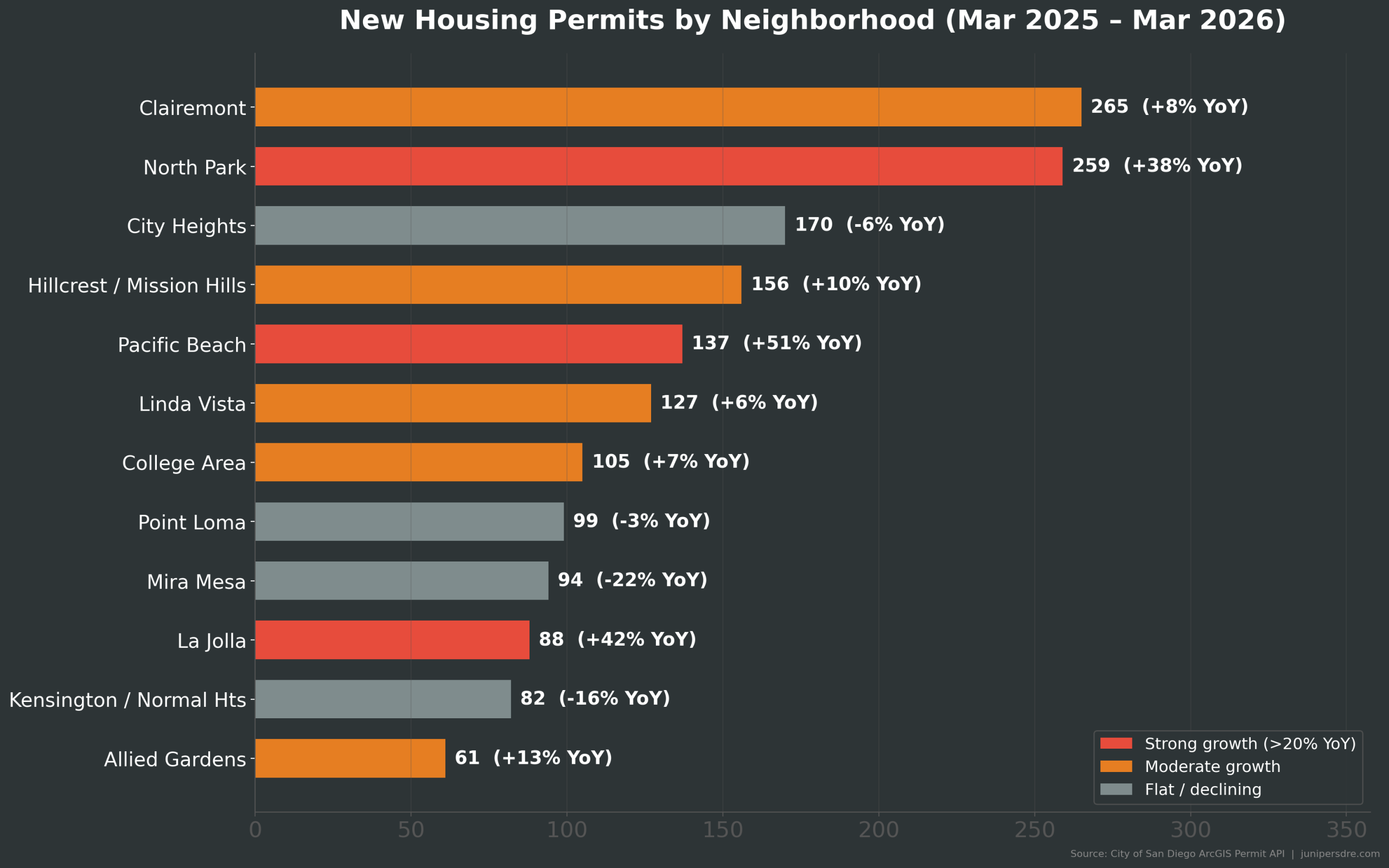
North Park is adding more new apartment buildings than any other neighborhood in the city. With 126 five-plus-unit apartment permits and 117 ADU permits, the construction boom is visible on nearly every block. Total new housing permits are up 37.8% year-over-year. The neighborhood is actively densifying, and the market is responding with 104% of list price and 30-day sales.
Linda Vista is the quiet surprise. Total building permits are up 32.9%, the fastest growth rate of any neighborhood in this dataset. It logged 96 ADU permits and 28 apartment building permits. Proximity to UCSD and the trolley line are catalysts. If you’re looking for the neighborhood that’s about to get a lot more attention, the data says Linda Vista.
Pacific Beach is seeing a coastal reinvestment wave. New housing permits are up 51% year-over-year, driven by 109 ADU permits as homeowners add rental units to capture beach-area rents. Single-family appreciation of 13.8% confirms the thesis.
College Area and Mission Valley complete the picture. College Area’s SDSU-driven demand and steady ADU construction make it a slow-burn growth story. Mission Valley is the bold bet. New construction is up 343%, and when SDSU Mission Valley opens, the neighborhood will look entirely different.
Up-and-coming isn’t a feeling. It’s a measurable pattern: permit activity surging, prices holding or rising, inventory tightening. If you see those three signals together, you’re looking at a neighborhood in transition.
What This Means for You
If you’re relocating to San Diego, start with the comparison table above. Filter by your budget, then visit your top three in person. The feel of a neighborhood matters, but the data narrows the list fast.
If you’re a first-time buyer, City Heights and Mission Valley condos offer the most accessible entry points under $700,000. College Area condos at $516,000 are another strong option, especially if you want appreciation potential backed by SDSU growth.
If you’re an investor, follow the ADU permits. Clairemont, City Heights, and College Area are where the money is going: 422 combined ADU permits in the last 12 months. The rental income math works, and the tenant placement pipeline is strong in all three.
If you’re thinking about selling, neighborhoods with under 1.5 months of supply (Allied Gardens, University City, Clairemont, Scripps Ranch, College Area) are strong seller’s markets right now. Demand is outpacing supply.
Let’s Talk Neighborhoods
Choosing the right San Diego neighborhood is one of the biggest decisions in the buying process, and the data only tells part of the story. Miguel Chairez has been helping San Diego buyers, sellers, and investors navigate these neighborhoods for over 20 years, from property valuations to negotiation strategy to finding the right block within the right neighborhood.
Whether you’re narrowing your list, evaluating an investment property, or ready to start looking, reach out anytime at 619.253.3333 or miguel(at)junipersdre(dotted)com.
Frequently Asked Questions
What is the best neighborhood to buy a home in San Diego in 2026?
It depends on your priorities. For families, Scripps Ranch and Mira Mesa offer top schools and strong lot sizes. For young professionals, North Park and Hillcrest deliver walkability and culture. For investors, City Heights and Clairemont have the strongest ADU and rental potential. See the comparison table above for a full side-by-side breakdown.
What is the most affordable neighborhood in San Diego?
City Heights has the lowest median home price among central San Diego neighborhoods at $703,000 for a single-family home. Mission Valley condos offer entry around $577,000. Chula Vista–Eastlake has single-family homes under $1 million in newer construction.
What are the up-and-coming neighborhoods in San Diego?
Based on building permit data and market trends, North Park, Linda Vista, Pacific Beach, and College Area show the strongest development momentum heading into 2026. North Park alone has 255 new housing permits, up 37.8% year over year.
Is it a good time to buy a home in San Diego?
It depends on the neighborhood. County-wide inventory is down 15.4% year-over-year, meaning less selection overall. But several neighborhoods have softening prices. La Jolla single-family homes are down 11% and Pacific Beach condos are down 14%, creating buying opportunities. The Housing Affordability Index has improved 5% as mortgage rates edged lower.
How much does a home cost in San Diego in 2026?
The county-wide median is $1,089,795 for a single-family home and $660,000 for a condo or townhome. But prices range dramatically by neighborhood: from $703,000 in City Heights to nearly $3.5 million in La Jolla. The comparison table above breaks down actual prices for 15 neighborhoods.
Data sources: San Diego MLS via SDAR FastStats, current as of March 5, 2026. Building permit data from City of San Diego Open Data Portal, current as of March 16, 2026.