

San Diego is 47% more expensive than the national average. The median single-family home just hit $1,100,000. Utility rates are among the highest in the country. And people keep moving here anyway, because the quality of life is genuinely hard to match anywhere else in the United States.
I have been a broker in San Diego for over 20 years, and I have helped hundreds of people navigate the transition from out of state to settled in a neighborhood that actually fits their life. This guide is built on the same data I use with my own clients: current MLS transaction data, real cost-of-living numbers, and honest assessments of what works and what catches newcomers off guard. No sugarcoating, no sales pitch. Just the information you need to make a smart move.
What It Actually Costs to Live in San Diego
The cost of living in San Diego is roughly 47% above the national average, according to Redfin’s 2026 data. Housing is the biggest driver at 110% above average, but it does not stop there. Utilities run 49% higher than the national average thanks to SDG&E’s electricity rates, groceries cost about 13% more, and transportation runs 43% above average. The Bureau of Labor Statistics reported that the San Diego CPI advanced 1.4% in the two months ending March 2026, with food prices up 2.2% year over year.
Here is what a realistic monthly budget looks like for a single person living in San Diego:
| Expense | Modest | Comfortable | Generous |
|---|---|---|---|
| Rent (1BR) | $1,800 | $2,500 | $3,200 |
| Utilities (SDG&E + water) | $200 | $280 | $400 |
| Groceries | $350 | $500 | $750 |
| Transportation (car + gas) | $400 | $600 | $900 |
| Dining + Entertainment | $200 | $500 | $1,000 |
| Total Monthly | $2,950 | $4,380 | $6,250 |
| Annual Income Needed | ~$60K | ~$95K | ~$130K+ |
Swipe to see all columns →
For a family of four, those numbers scale to roughly $145,000 on the modest end and $210,000 or more for a comfortable life. Under the 50/30/20 budgeting rule, a single adult needs approximately $136,781 per year and a family of four needs $312,915 to live comfortably in San Diego, according to SmartAsset. The median household income in San Diego is between $89,457 and $105,780, depending on the source, which means many residents are stretching.

Photo: Pexels
Renting vs. Buying: Your Housing Options
Average rent for a one-bedroom apartment in San Diego County ranges from $2,100 to $3,000 per month depending on the neighborhood. A two-bedroom runs $2,700 to $3,600. Most landlords require proof of income at three times the monthly rent, and a typical move-in requires first month, last month, and a security deposit, putting your upfront cost at $6,000 to $9,000 before you buy a single piece of furniture.
Buying is a different calculation entirely. The county-wide median single-family home hit $1,100,000 in March 2026, up 2.4% year over year. Condos and townhomes are more accessible at a $670,000 median, down 1.1% from last year. According to the California Association of REALTORS, you need a household income of $243,600 per year to qualify for the median-priced home in San Diego. Only 15% of San Diego households can afford that. The entry-level path is condos: 30% of households can afford the entry-level price of $844,900, which requires $160,800 per year.
If you are moving to San Diego and plan to buy, the first-time buyer’s guide breaks down the full process, including down payment assistance programs specific to San Diego County.
The Best San Diego Neighborhoods for New Residents
San Diego County covers 4,526 square miles and contains more than 100 distinct neighborhoods. The right one depends on your budget, your commute, and whether you prioritize walkability, schools, nightlife, or beach access. Here is a neighborhood-by-neighborhood breakdown using March 2026 closed transaction data from the Greater San Diego Association of REALTORS.

Photo: Pexels
Budget-Friendly (Under $800K Single-Family Home)
City Heights ($730,000 SFH median, $530,000 condo) is the most affordable entry point inside the city of San Diego. It is diverse, improving rapidly, and about 20 minutes from downtown. Condos here start in the $400,000s. La Mesa ($1,082,500 SFH, $495,000 condo) is technically outside the city limits but feels like a San Diego neighborhood. The walkable village center, strong schools including Helix Charter High (rated 10/10 on GreatSchools), and more space for the money make it popular with families. The College Area ($970,000 SFH, $438,000 condo) around San Diego State University offers investment potential and some of the most affordable condos in the county.
Mid-Range ($900K to $1.2M Single-Family Home)
Clairemont ($1,139,500 SFH, $515,000 condo) is a master-planned neighborhood 15 minutes from the beach with the tightest inventory in the county at 0.9 months of supply. Homes here sell fast. Mira Mesa ($1,100,000 SFH, $630,000 condo) sits near Miramar and the Convoy Street food corridor, one of the best Asian dining districts on the West Coast. It is family-friendly with solid schools. North Park ($1,127,500 SFH, $595,000 condo) is walkable, culturally vibrant, packed with independent coffee shops, craft breweries, and a weekly farmers market. Three elementary schools here are rated 9/10.
Premium ($1.2M to $2M Single-Family Home)
Hillcrest and Mission Hills ($1,504,500 SFH, $740,000 condo) sit at the edge of Balboa Park with walkable dining, nightlife, and some of the best urban living in San Diego. Point Loma ($1,677,000 SFH, $1,018,000 condo) is selling the fastest in the county at just 15 days on market. Liberty Station, Sunset Cliffs, and proximity to the airport make it a perennial favorite. Pacific Beach ($2,350,000 YTD SFH median, $1,106,000 condo) is the quintessential beach town, popular with younger buyers and investors looking at rental income.
Luxury ($2M and Above)
La Jolla ($3,500,000 YTD SFH median, $1,285,000 condo) has the best schools in the county. Every public school from La Jolla Elementary through La Jolla High is rated 10 out of 10. It is also home to UC San Diego and the core of San Diego’s biotech corridor. Carmel Valley ($2,701,000 YTD SFH, $1,200,000 condo) is a master-planned family suburb with top-rated schools and easy access to both the coast and the I-5/56 freeway interchange.
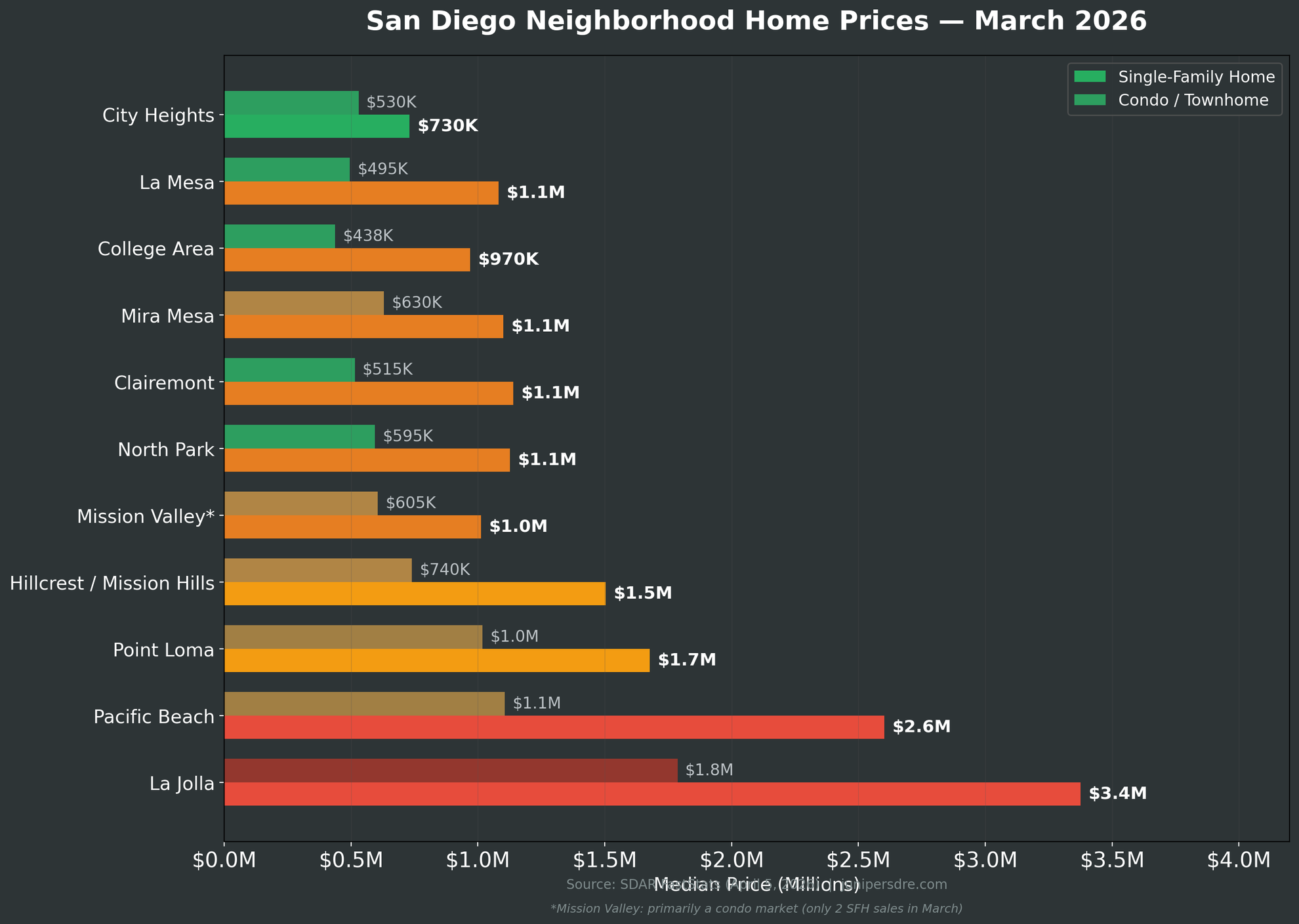
The full breakdown of all 15+ neighborhoods with detailed market stats is in the best neighborhoods guide.
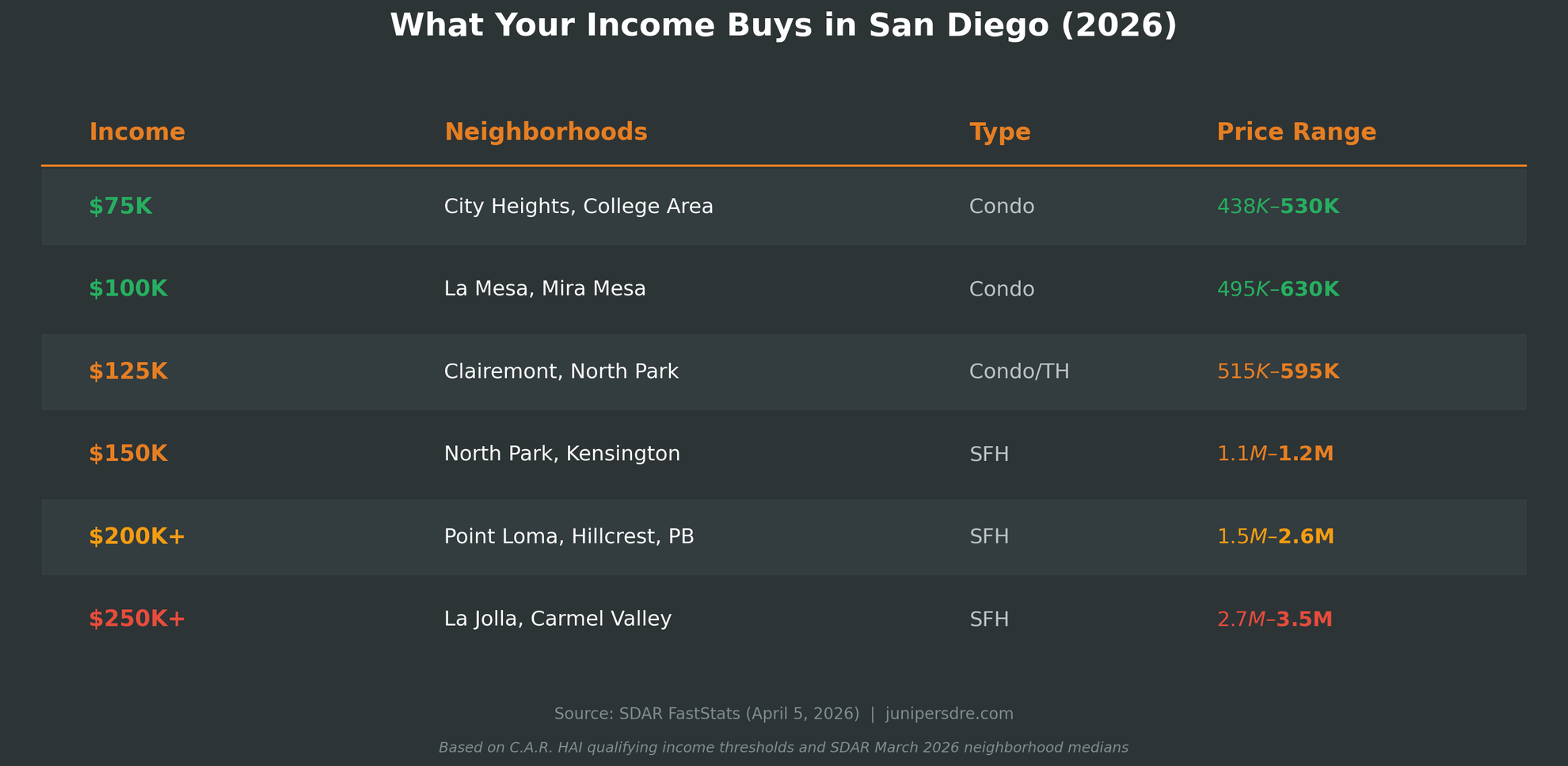
The San Diego Job Market in 2026

Photo: Pexels
San Diego’s unemployment rate was 4.7% in January 2026, below California’s 5.5% and tied with the national rate. The region added 10,900 jobs year over year, and in February 2026, the city of San Diego posted more new monthly job ads (1,836) than Los Angeles or San Francisco.
The biggest growth engine is healthcare and education, which added 16,600 jobs over the past year. The top employers actively hiring in San Diego right now are Qualcomm (672 open positions), UC San Diego (642), General Atomics (542), Apple (503), and Scripps Health (459). The most in-demand roles are retail salespersons (1,392 openings), home health aides (1,315), registered nurses (1,297), and software developers (1,011).
The economy here is what labor economists call “two-speed.” If you work in healthcare, biotech (Illumina, Dexcom, Aspen Neuroscience), defense (General Atomics, SPAWAR), or cybersecurity, the job market is strong and competitive. San Diego is one of the top three biotech hubs in the world, and the cybersecurity cluster grew 11% over the past two years. If you work in general tech or professional services, hiring has slowed and it takes longer to land. Know which speed your industry is running at before you commit to the move.
The military and defense presence is substantial. Naval Base San Diego, Marine Corps Air Station Miramar, and Camp Pendleton (just north of the county line) create thousands of civilian jobs in engineering, logistics, and contracting. If you are a veteran, VA loan benefits go further in San Diego than almost any other major metro because of the high conforming loan limit ($1,104,000 in 2026).
Getting Around San Diego

Photo: Pexels
San Diego is a car city. The MTS trolley system and bus network exist and are usable for some commutes, particularly along the Blue Line (downtown to the border) and the Green Line (downtown to SDSU and Santee), but they do not cover most neighborhoods effectively. If you live in North Park and work in Sorrento Valley, your commute by transit would be well over an hour. By car, it is 20 minutes outside rush hour.
Average commute time is 25 to 30 minutes by car. The intersections of I-5, I-8, and CA-163 can add 15 to 20 minutes during peak hours. Gas runs about $3.98 per gallon, above the national average but below the San Francisco and Los Angeles metro areas.
There are walkable exceptions. North Park has a Walk Score of 88. Hillcrest scores 85. Little Italy and downtown are genuinely walkable for daily errands and dining. Bike infrastructure is growing, particularly along the coast, but it is still patchy for commuting. If you plan to live without a car, your neighborhood options narrow significantly.
Schools and Family Life
San Diego Unified School District serves most of the city, with several smaller districts covering suburban areas. School quality varies dramatically by neighborhood, which is one of the reasons location matters so much when buying with kids.
The standout school pipelines by neighborhood:
- La Jolla: Every public school from elementary through high school is rated 10/10 on GreatSchools. La Jolla Elementary, Muirlands Middle, and La Jolla High form one of the strongest K-12 public school pipelines in Southern California.
- Pacific Beach: A rare K-12 International Baccalaureate feeder chain. Sessions Elementary (IB PYP) feeds into Pacific Beach Middle (IB MYP, rated 9/10) and then Mission Bay High (IB Diploma Programme, rated 9/10).
- North Park: Three elementary schools rated 9/10 (McKinley, Jefferson, Garfield). McKinley is an IB World School.
- La Mesa: Helix Charter High School, rated 10/10, with a strong STEM and college prep program.
Private school options include Francis Parker School, The Bishop’s School in La Jolla, and Gillispie School. Family activities are abundant: Balboa Park offers free admission to a rotating set of museums every Tuesday, the San Diego Zoo is world-class, LEGOLAND is 30 minutes north in Carlsbad, and the beaches are free every day of the year.
What Locals Wish They Had Known First

Photo: Pexels
Every month, someone posts in the San Diego subreddit asking what they should know before moving here. The answers are remarkably consistent, and they echo what my clients tell me after their first year. Here are the things that catch people off guard most often.
SDG&E bills will shock you. San Diego Gas & Electric charges some of the highest electricity rates in the country, over 38 cents per kilowatt-hour. Budget $200 to $400 per month for a house, especially if you run air conditioning. Apartments tend to be lower, but your first summer bill will still surprise you.
It has gotten hotter. Inland neighborhoods like Clairemont, Mira Mesa, and La Mesa routinely hit 100 degrees or more in the summer. Air conditioning is no longer optional in these areas. Coastal neighborhoods stay cooler, but the tradeoff is higher rent and home prices.
The scale of the county surprises people. San Diego County is 4,526 square miles. Point Loma to Scripps Ranch is 30 minutes on a good traffic day. “San Diego” is not one place; it is a collection of neighborhoods that feel like different small cities.
Traffic is real, just not LA-level. The merge where I-5, I-8, and CA-163 converge near Mission Valley will eat your commute. Weekday mornings heading south on I-5 through Sorrento Valley are reliably slow. Weekend traffic to the beach is a thing, especially in summer. Time your drives.
“June Gloom” is real. May through mid-June brings a persistent marine layer to the coast. Mornings are gray and cool, burning off by midday most days. It surprises people who expect constant sunshine, but locals learn to love it. It keeps summers comfortable.
The food scene is world-class. Fish tacos are a way of life. The Convoy Street Asian food corridor is one of the best in the country. North Park and Hillcrest have more restaurants per block than most neighborhoods in LA. San Diego is the craft beer capital of the United States, with over 150 breweries in the county. The farmers markets are excellent, particularly North Park on Thursdays, Pacific Beach on Saturdays, and Little Italy‘s Mercato on Saturdays.
Your First 30 Days in San Diego
Week 1: Get your California driver’s license. State law requires it within 10 days of establishing residency. Update your vehicle registration within 20 days. Set up your SDG&E account (they require it even if your landlord handles water). Forward your mail through USPS.
Week 2: Open a local bank account or credit union. San Diego County Credit Union and Mission Federal Credit Union are popular local options with branches throughout the county. Find a primary care physician through Scripps, Sharp, or Kaiser Permanente networks.
Week 3: Explore your neighborhood on foot. Hit the farmers market closest to you: North Park on Thursdays, Pacific Beach on Saturdays, Clairemont on Saturdays, Point Loma on Sundays. Find your regular coffee shop and your go-to taco spot. These small routines are how you stop feeling like a tourist.
Week 4: Get outside. Hike Cowles Mountain for the best accessible view of the county. Walk Torrey Pines State Reserve. Spend a sunset at Sunset Cliffs in Point Loma. Paddle Mission Bay. By the end of week four, you will understand why people put up with the cost.
The Honest Pros and Cons
| Pros | Cons |
|---|---|
| 266 sunny days per year | 47% higher cost of living vs. national avg |
| World-class beaches, hiking, outdoor lifestyle | SDG&E rates (38+ cents/kWh) |
| Biotech, defense, and healthcare job pipeline | Car dependency for most neighborhoods |
| Diverse, distinct neighborhoods | Only 15% can afford the median home |
| Fish tacos, Convoy Street, 150+ breweries | June Gloom (May through mid-June) |
| Proximity to Mexico, wine country, desert | Traffic on I-5/I-8/163 corridors |
Swipe to see all columns →
What This Means for You
If you are relocating for work: Choose your neighborhood based on commute first, lifestyle second. Sorrento Valley and UTC for biotech. Mission Valley for central freeway access. Mira Mesa for defense contractors near Miramar. Living close to work in San Diego saves more money and sanity than any other single decision you will make.
If you are coming with a family: Schools narrow your options fast. La Jolla has the strongest public school pipeline in the county, but the price of entry is $3.5M for a house. Pacific Beach‘s IB program is excellent at a lower price point. North Park offers walkability plus three 9/10 elementary schools. For more affordable family options, La Mesa and Clairemont deliver strong schools with single-family homes under $1.15M.
If you are moving solo in your 20s or 30s: North Park, Hillcrest, and Pacific Beach are where the social life is. Budget $2,000 to $2,800 per month for a one-bedroom. Walkability matters when you are building a social life; these three neighborhoods deliver it.
If you are an investor: City Heights, College Area, and La Mesa have the strongest price-to-rent ratios. Mission Valley condos have the most inventory in the county at 5.2 months of supply, which means negotiating room for buyers. The county-wide March 2026 market report breaks down the full picture.
Frequently Asked Questions
Is $100,000 a good salary in San Diego?
It depends on your household size. For a single person, $100,000 puts you in the moderate comfort range, but homeownership is a stretch. The median San Diego home requires $243,600 per year to qualify for a mortgage. At $100K, condos in City Heights ($530,000) or Mira Mesa ($630,000) are more realistic targets. The median wage in San Diego County is $88,500, so $100K puts you above the midpoint.
What salary do you need to live comfortably in San Diego?
Under the 50/30/20 budgeting rule, a single adult needs approximately $136,781 per year and a family of four needs $312,915 to live comfortably. “Comfortable” means covering housing, contributing to retirement, building an emergency fund, and absorbing unexpected expenses without financial stress. A single person earning $95,000 can live well in San Diego but will need to be intentional about budgeting.
Is San Diego a good place to move to in 2026?
San Diego added 10,900 jobs year over year through January 2026, led by 16,600 new positions in healthcare and education. The unemployment rate is 4.7%, below California’s 5.5%. The median home price rose 2.4% year over year to $1,100,000 in March 2026, and inventory dropped 21.5%. The quality of life is high, but so is the cost of entry. If your income supports it, the combination of weather, jobs, outdoor access, and cultural depth is hard to beat.
What is the cost of living in San Diego compared to the national average?
San Diego’s cost of living is 47% above the national average, according to Redfin’s 2026 data. Housing is the biggest factor at 110% above average. Utilities run 49% higher thanks to SDG&E electricity rates, groceries are 13% higher, and transportation costs 43% more. The Bureau of Labor Statistics confirmed a 1.4% CPI increase for the two-month period ending March 2026.
What are the best neighborhoods in San Diego for families?
La Jolla has the strongest school pipeline, with every public school from elementary through high school rated 10/10 on GreatSchools. Pacific Beach offers a K-12 International Baccalaureate feeder chain across three schools. North Park has three elementary schools rated 9/10. For more affordable family options, La Mesa offers Helix Charter High (10/10) with single-family homes starting around $1,082,500, and Clairemont has solid schools with homes under $1.15M.
Moving to San Diego is a big decision, and the market here does not wait. If you want to talk through neighborhoods, pricing, or timing, I am happy to walk you through it.
Miguel Chairez, Juniper Real Estate Co.
619.253.3333 | miguel(at)junipersdre(dotted)com
Contact Miguel | Buyer Services | Property Management
Data sources: Greater San Diego Association of REALTORS® FastStats (current as of April 5, 2026), California Association of REALTORS® Q4 2025 Housing Affordability Index, Bureau of Labor Statistics Consumer Price Index for San Diego-Carlsbad (March 2026), San Diego Union-Tribune employment data (April 2026), Redfin Cost of Living Calculator (2026), GreatSchools.org ratings (March 2026).