
Moving to San Diego with kids starts with one number: the ZIP code you choose swings your housing budget by up to $1.9 million and determines which schools your children can attend for the next decade.
I scraped 322 active listings across eight family-friendly ZIP codes on April 28, 2026. The median price spread runs from $1,099,000 in Clairemont to $2,995,000 in La Jolla. Two families with identical budgets and identical school priorities will land in completely different cities depending on which direction they search.
Every relocation guide sends families to the same five neighborhoods: Carmel Valley, Scripps Ranch, Poway, Rancho Bernardo, Rancho Peñasquitos. All solid options. All starting at $1.4 million for a 1980s tract home, most carrying Mello-Roos taxes that never appear on a listing.
What almost no guide covers is the second tier: older San Diego neighborhoods with walkable streets, mature tree canopy, strong public schools, and median prices 30 to 60 percent below the suburban belt. I cover those markets every week. This guide walks through all three tiers and eight neighborhoods, with current prices, school ratings, and the full cost math.
1. The price reality across 8 family neighborhoods
Across 322 active listings scraped April 28, 2026, the spread between the cheapest and most expensive family neighborhood in San Diego is almost 3 to 1. That gap matters more than any other single number in this guide.
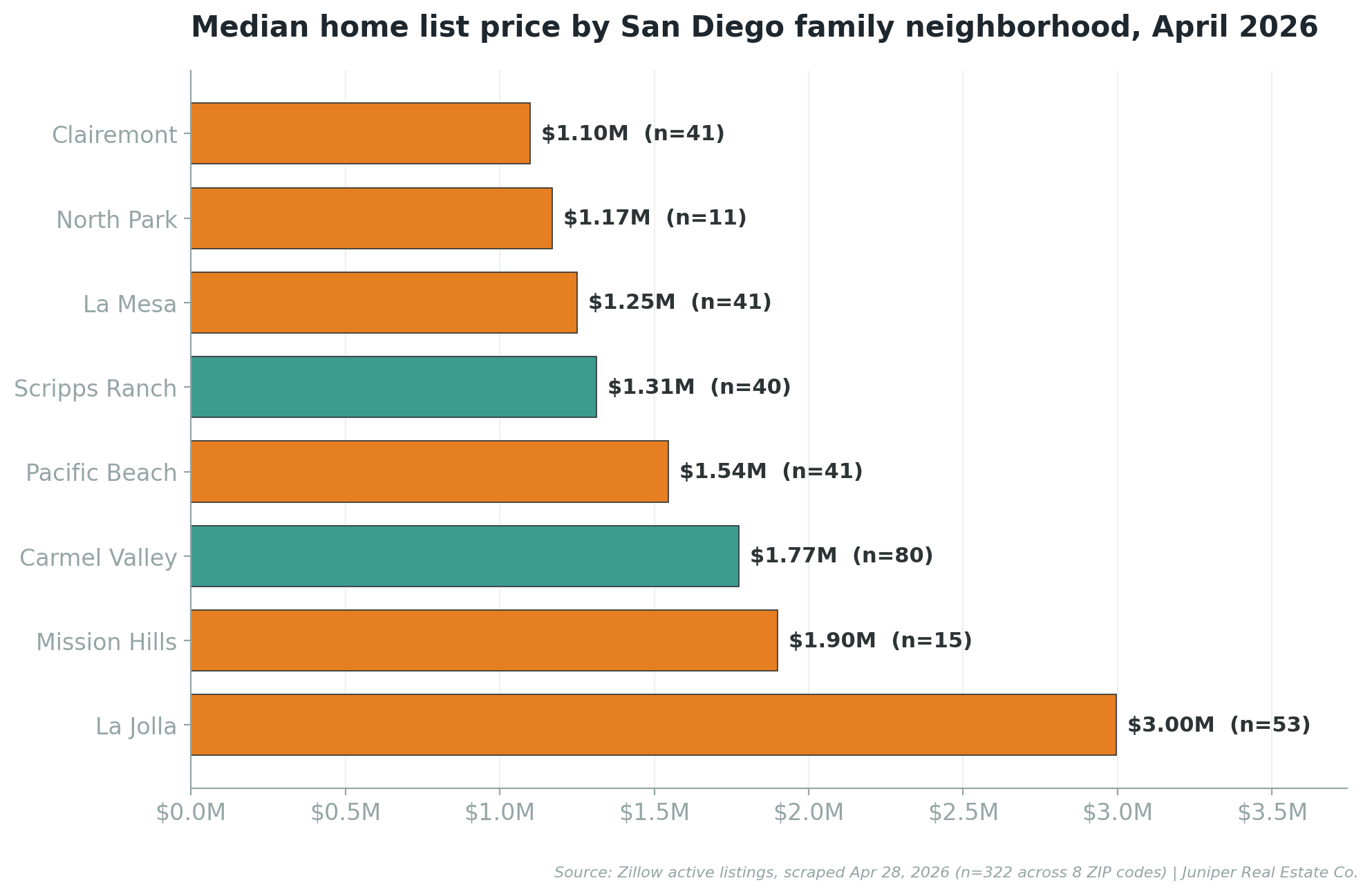
Orange bars = Juniper coverage area (in-city + East County). Teal bars = North County / suburban belt. Source: Zillow active listings, scraped Apr 28, 2026 (n=322 across 8 ZIP codes) | junipersdre.com
Three things to notice.
First, the spread. Clairemont’s median sits at $1,099,000. La Jolla’s is $2,995,000. A family comparing those two neighborhoods is not looking at two price points for the same thing. They are looking at two different versions of San Diego life, and the choice compounds for years through schools, commute, and community.
Second, Carmel Valley does not win on price. It comes in sixth at $1,774,500, well above Clairemont, North Park, La Mesa, Scripps Ranch, and Pacific Beach. Families pay that premium for one thing: schools. Whether that math holds up is covered in section five.
Third, the in-city options sit at the bottom of the price list. Clairemont, North Park, La Mesa, and Pacific Beach all come in under $1.55M. These are real family neighborhoods with strong school options that almost no relocation guide covers in depth. That is the gap this article exists to fill.
One thing our research made clear: there is no such thing as a “flexible budget” in this market. Budget realism is the starting point, not a caveat. Across all eight neighborhoods, $1.1 million is the floor for a three-bedroom single-family home in a strong school zone. Plan from there.
2. Tier 1: The suburban family belt
This is the consensus answer. Search for best San Diego neighborhoods for families and you get this list every time.
Carmel Valley (92130): schools-first, $1,774,500 median
Carmel Valley is what most relocation guides mean when they say “best for families.” Master-planned, walkable within each pod, almost no through traffic, and the schools are top-tier. Sage Canyon Elementary, Carmel Del Mar Elementary, and Ocean Air Elementary all rate 9-10 on GreatSchools. The high school tracks (Canyon Crest Academy, Torrey Pines High) are among the most academically competitive in San Diego County.
The trade-off is community feel. From our research, parents who have lived in Carmel Valley consistently describe it as a neighborhood organized around school performance more than neighborhood community. Most families there chose it specifically for the schools, and the day-to-day lifestyle reflects that priority. If top-tier academics at every grade level is the primary goal and budget allows, Carmel Valley delivers. If walkable street life and organic neighborhood connection matter as much as the schools, Tier 2 is worth a serious look.
You are paying a $500K-$700K premium over Clairemont or La Mesa for the schools.
Add to your math: newer phases of Carmel Valley carry Mello-Roos assessments of $3,000 to $5,000 per year on top of property tax. Older sections (closer to I-5) typically do not. Always ask before you write an offer.
Scripps Ranch (92131): community vibe leader, $1,314,000 median
Scripps Ranch is what families often actually want when they think they want Carmel Valley. The price is lower (median $1.31M, almost half a million less), the schools are still excellent (Dingeman Elementary 10/10, Jerabek Elementary 9/10, Miramar Ranch Elementary 9/10), and there is a genuine neighborhood feel. Block parties, kids at the parks, eucalyptus tree canopy from the original 1970s community plan.
Our research found a consistent pattern among Scripps Ranch families: it works extremely well for the school-age years and feels less tailored to life once the kids leave. Family-belt neighborhoods have a lifecycle, and Scripps Ranch is built for that family-raising decade.
The trade-off: Scripps Ranch has no walkable restaurant or nightlife scene. You drive 15-20 minutes for that. A car is required for everything. Most parts of Scripps Ranch carry Mello-Roos of $2,500 to $4,000 per year.
University City (92122): La Jolla-adjacent, $1.2M+ entry
University City sits between La Jolla and Carmel Valley, and that location is its core advantage. Walking distance to UTC mall, fast access to UCSD and the major hospital systems, and a public school pipeline that includes Curie Elementary (10/10), Standley Middle, and University City High.
Families familiar with the area summarize it the same way: it checks every box for schools, safety, and access, with price entry at $1.2 million or more as the one significant constraint. Inventory turns over slowly because most families buy once and stay through the school years. If you find the right house, move quickly.
3. Tier 2: In-city walkable family neighborhoods
This is the tier almost nobody writes about. These are older San Diego neighborhoods, built between the 1920s and 1960s, with mature trees and Spanish-revival or mid-century housing stock, where families have lived for generations. The schools are often surprisingly strong, the walkable density is unmatched in suburban tracts, and the prices come in 30 to 60 percent below Carmel Valley.
Clairemont (92117): quietly the best value, $1,099,000 median
Clairemont was master-planned in 1950 as a neighborhood for young families. Seventy-five years later, that is exactly what it still is. Six elementary schools serve the area, including John Muir Language Academy (PreK-8, GreatSchools 9/10), which runs a 90/10 Spanish immersion program, and Bay Park Elementary (8/10). A median price under $1.1M covers a 1,400-1,800 sqft single-family home with a yard. Quick freeway access to almost anywhere via I-805 and I-5. No Mello-Roos.
If a buyer came to me with a $1.2M budget and elementary-age kids, Clairemont is the first place I would look. See my Clairemont neighborhood guide for the deeper breakdown of schools, sub-pockets, and current inventory.
University Heights (92104 / 92103): IB pipeline, $1.3M-$1.7M typical
University Heights has one of the best public-school stories in central San Diego. Alice Birney Elementary (K-5, GreatSchools 10/10) is an International Baccalaureate Primary Years Programme magnet. A 10/10 GreatSchools rating in a central urban neighborhood is exceptionally rare. Birney feeds into Roosevelt International Middle (IB MYP) and San Diego High (IB DP), giving families a complete K-12 IB pipeline without leaving the neighborhood.
The neighborhood itself is dense, walkable, and dotted with cafes, restaurants, and parks. Park Boulevard runs through it with Balboa Park to the south. My University Heights guide walks through the schools, housing stock (mostly 1920s craftsman and Spanish bungalow), and what each block feels like.
North Park (92104): three 9/10 elementaries, $1,169,000 median
North Park is the densest concentration of strong elementary schools in central San Diego. McKinley Elementary (9/10) is an IB PYP World School. Jefferson Elementary (9/10) and Garfield Elementary (9/10) round out three 9/10 neighborhood elementaries inside one ZIP code. That kind of school cluster is hard to find at this price point anywhere in the county.
The catch: secondary schools drop off. Hoover High (3/10) is the zoned high school. Many North Park families use SDUSD’s district-wide school choice program to access higher-rated middle and high schools, including the IB track at Mission Bay High in Pacific Beach (9/10). The choice system is real, parents do use it, and it works. Plan for the choice application timeline if you go this route.
What you get for $1.17M: a 1920s-1940s craftsman or Spanish bungalow, often 1,200-1,800 sqft, walking distance to 30th Street’s restaurant strip, breweries, and parks. My North Park neighborhood guide details the sub-pockets and how to read the listings.
Pacific Beach (92109): full K-12 IB feeder chain, $1,545,000 median
Pacific Beach has a full International Baccalaureate K-12 feeder chain, one of the few in San Diego. Kate Sessions Elementary (8/10) runs the IB PYP. Pacific Beach Middle School (9/10) runs the IB MYP. Mission Bay High School (9/10) is the IB Diploma Programme school. Math proficiency across the cluster runs at 57% versus 34% statewide; reading at 68% versus 47%.
The lifestyle premium is real: walkable to the boardwalk, surf, and bay. Mature elementary cohorts that travel together through the IB years. The trade-off is the rest of PB, specifically bars on Garnet, summer crowds, and parking. Families who pick Pacific Beach usually live north of Garnet (the Crown Point or Kate Sessions side) where the school catchment is calmer and the streets are quieter. My Pacific Beach guide breaks the neighborhood into sub-areas with school assignment notes.
Kensington (92116): character neighborhood with strong elementary, $1.5M+ typical
Kensington sits just east of North Park and shares a similar character: 1920s Spanish-revival homes on walkable streets, a strong neighborhood identity, and a tight-knit community feel. Garfield Elementary (9/10) is the neighborhood anchor school. Families who want the in-city walkable lifestyle but find North Park too dense tend to land here. Inventory is limited; this is a slow-turnover neighborhood with high owner loyalty.
Mission Hills (92103): Uptown elegance, $1,900,000 median
Mission Hills is the quietest, most architecturally consistent of San Diego’s Uptown neighborhoods. Spanish revival and craftsman homes from the 1910s-1930s, mature canopy, walkable to Hillcrest and Old Town. The neighborhood anchor school is Grant K-8 (TK-8 with Gifted and Talented programming). Families who pick Mission Hills tend to be in the can-pay-for-private-if-needed bracket, and many use SDUSD school choice to access Alice Birney (10/10) or other magnets.
Median price is $1.9M and reflects scarcity. Very few homes turn over each year. My Mission Hills guide covers what listings actually look like and how the limited inventory works in practice.
La Jolla (92037): premium tier, $2,995,000 median
La Jolla is the only San Diego neighborhood with all three K-12 levels at 10/10. La Jolla Elementary (10/10), Bird Rock Elementary (10/10), Muirlands Middle (10/10), La Jolla High (10/10). Add Stella Maris Academy (a 2005 Blue Ribbon private K-8) and Gillispie School (Reggio-inspired, 70-year history). Between the public 10/10 pipeline and the private options, La Jolla offers more educational choices in one neighborhood than almost any other community in the county.
The price is the price. Median $2,995,000, with the upper quartile at $6.2M. If your budget puts you here, you are buying the schools and the address, and both deliver. My La Jolla neighborhood guide walks through the seven sub-villages and how each fits different family lifestyles.
4. Tier 3: East County value
La Mesa / Mt. Helix (91941): Helix Charter HS 10/10, $1,250,000 median
La Mesa is the strongest argument for moving slightly inland. Two public school assets stand out: La Mesa Arts Academy (4-8 magnet, GreatSchools 9/10), where visual arts, dance, music, and theater are integrated into the core curriculum, and Helix Charter High School (GreatSchools 10/10), ranked among the top 30 charter high schools in the country by Niche with a 97% graduation rate and 35 varsity sports.
La Mesa uses a different district structure than the City of San Diego. The La Mesa-Spring Valley School District covers TK-8, and Grossmont Union High School District covers high school. Both are stronger than families moving from outside San Diego County tend to assume.
The trade-off is location: La Mesa sits about 12 miles east of downtown, with summers that run noticeably hotter than the coast. The Mt. Helix area has views, larger lots, and cul-de-sac streets that families love.
The price story: $1.25M median for a single-family home with a yard, in a neighborhood with two elite public school options. That is roughly $525,000 less than Carmel Valley for comparable square footage. My La Mesa guide covers Mt. Helix specifically and walks through Helix Charter’s draw.
5. Schools by neighborhood: where the 9s and 10s actually are
Schools drive more family relocation decisions in San Diego than any other factor. Here is the at-a-glance picture across all eight family neighborhoods, showing the top school in each area and its GreatSchools rating.
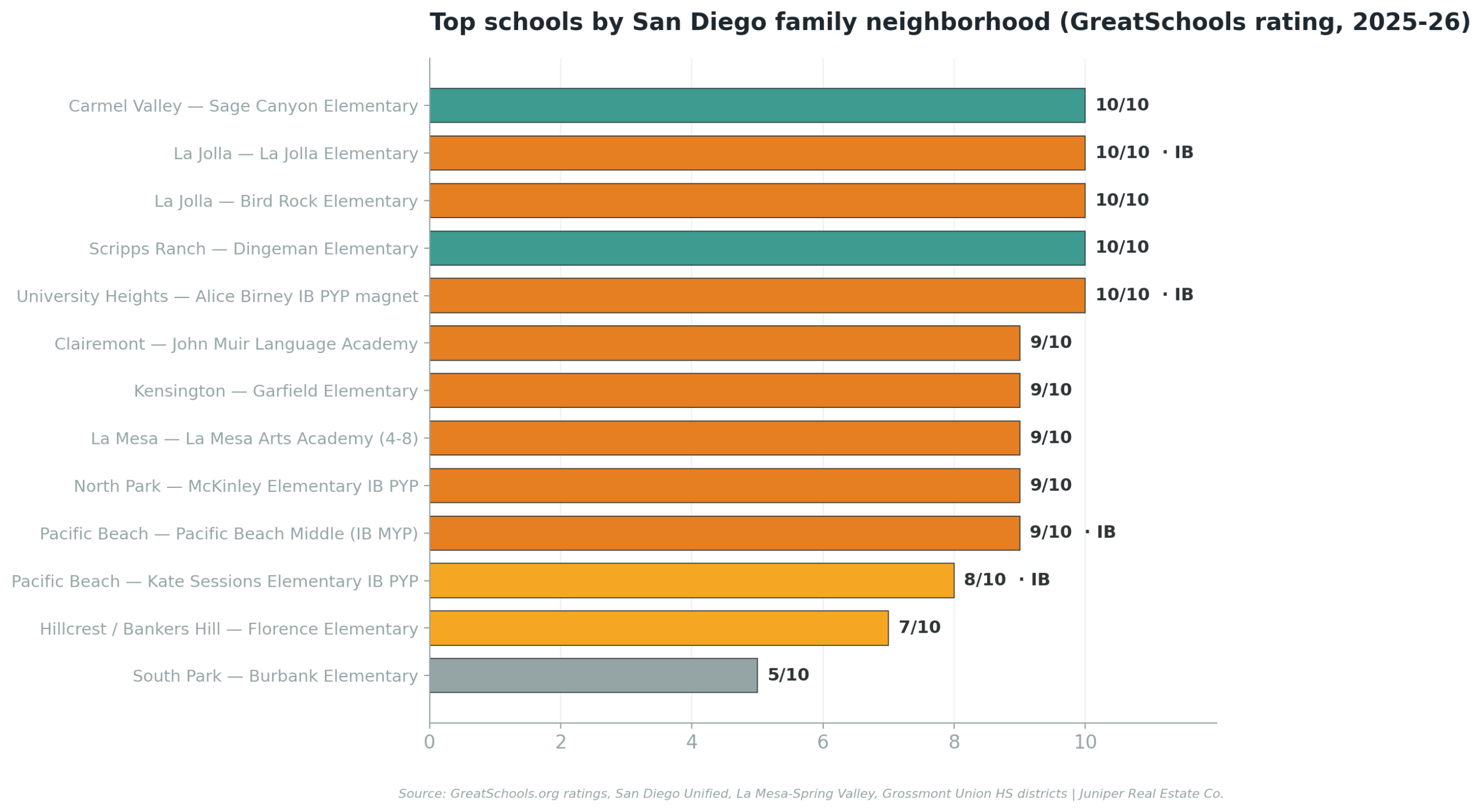
Orange bars = Juniper coverage area. Teal bars = North County / suburban belt. “IB” = school participates in the International Baccalaureate program. Source: GreatSchools.org, San Diego Unified School District, La Mesa-Spring Valley, Grossmont Union HS District (2025-26 data) | junipersdre.com
Three patterns to notice.
First, 10/10 elementary schools are not exclusive to high-priced ZIP codes. Alice Birney in University Heights and Helix Charter HS in La Mesa both deliver elite-tier outcomes at price points well below La Jolla or Carmel Valley. If you optimize for school quality alone, the price math changes significantly.
Second, the IB program presence is concentrated in coastal and urban core neighborhoods. Pacific Beach has the only complete K-12 IB feeder chain. University Heights has K-5 plus IB middle and high accessible via school choice. Hillcrest, Mission Hills, North Park, and Bankers Hill all share access to the same IB middle and high school options (Roosevelt International and San Diego High). If IB is the goal, those are your neighborhoods.
Third, SDUSD’s school choice system is real and worth understanding. Within San Diego Unified, families can apply to attend any school in the district subject to space. North Park families regularly send kids to Mission Bay High (9/10) for the IB track. Mission Hills and University Heights families regularly apply for Alice Birney (IB PYP, 10/10). The application window opens in October each year. Most relocating families miss this and assume they are locked into their zoned school. They are not.
One note for East County: La Mesa-Spring Valley School District (TK-8) and Grossmont Union HS District are separate from SDUSD. If you are weighing Tierrasanta or Mission Trails area against La Mesa, the district difference matters. La Mesa-Spring Valley has its own enrollment process and is generally easier to navigate than SDUSD.
6. Hidden costs: Mello-Roos, HOAs, and the real monthly number
Mello-Roos is the single most under-disclosed cost in San Diego family-belt buying. It does not appear on Zillow. It does not appear in MLS listings. Most relocating buyers learn about it from their loan estimate after they are already under contract, by which point the math may have moved against them.
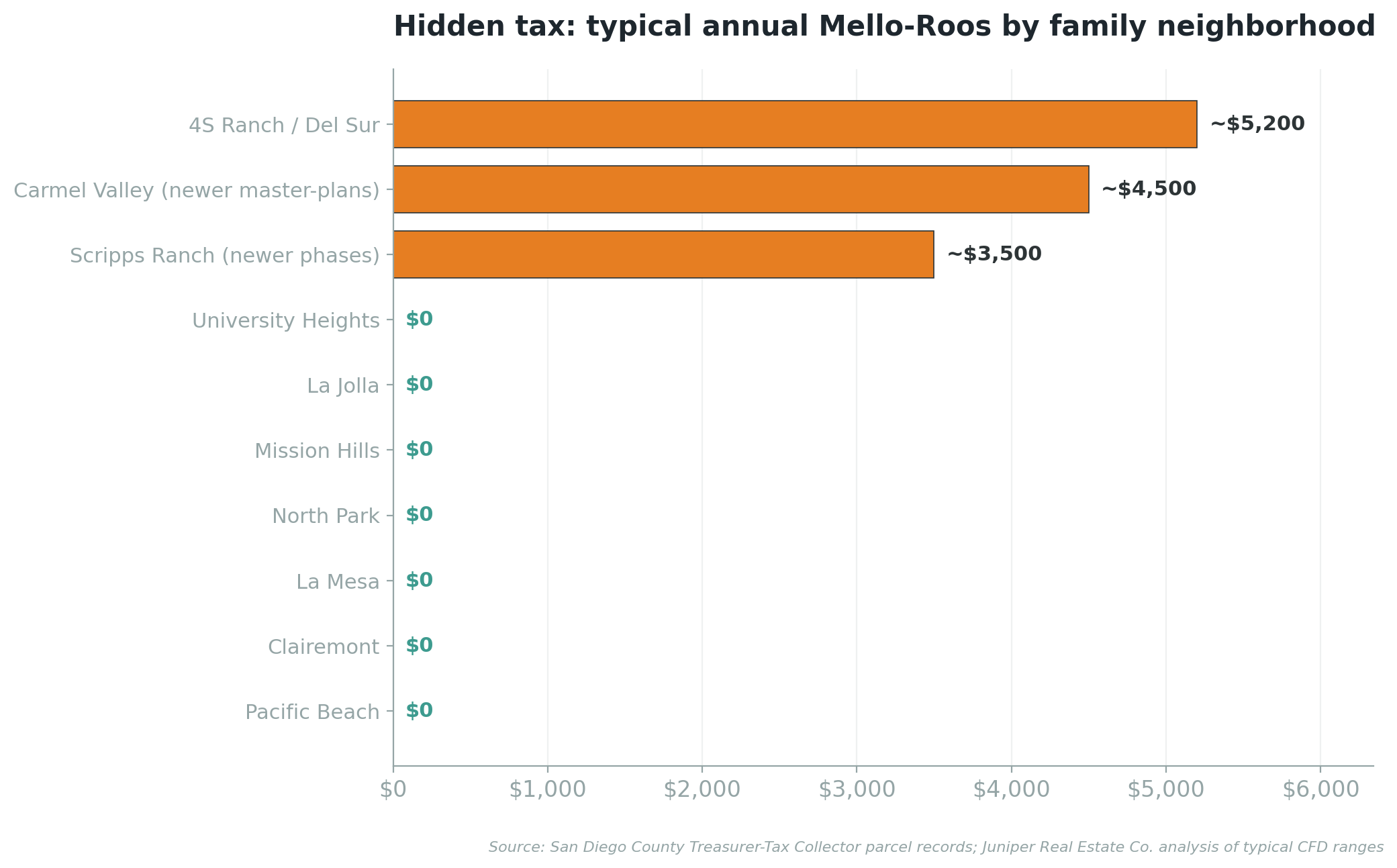
Source: San Diego County Treasurer-Tax Collector parcel records; Juniper Real Estate Co. analysis of typical CFD ranges by community
What Mello-Roos actually is
Mello-Roos is a special tax on homes in California Community Facilities Districts, originally created to fund infrastructure (roads, schools, fire stations) in areas built after 1982. It is collected as part of your property tax bill and shows up as a separate line item once you own the home. The amount is fixed when the development is built and varies by community.
In San Diego County, the family-belt neighborhoods with significant Mello-Roos exposure include:
- Carmel Valley (newer phases east of El Camino Real): typically $3,000 to $5,000 per year
- Scripps Ranch (newer master-planned sections): typically $2,500 to $4,000 per year
- 4S Ranch and Del Sur: typically $4,000 to $6,000 per year
- Carmel Mountain Ranch: typically $1,500 to $3,000 per year
- Mission Valley (newer condos): typically $1,500 to $3,000 per year
The older, in-city Tier 2 neighborhoods, including Clairemont, North Park, La Mesa, Pacific Beach, La Jolla, Mission Hills, and University Heights, are mostly built before 1982 and carry zero Mello-Roos in most cases. That alone tilts the cost-of-ownership math toward Tier 2 whenever school quality is comparable.
HOA fees layer on top
Most master-planned suburbs also carry HOA fees of $100 to $300 per month. Condo HOAs in Pacific Beach, Mission Valley, or Little Italy run $400 to $700 per month. A family buying in Carmel Valley with $4,000/yr Mello-Roos and a $200/mo HOA is paying an additional $6,400 per year, roughly $533 per month, that the listing price never showed them.
The real monthly number
To compare apples to apples, ask three questions before any offer:
- Does this property have a Mello-Roos assessment, and what is the annual amount?
- What is the HOA fee, and what does it cover?
- What is the prior year’s total property tax bill, including all special assessments?
The seller’s agent is required to disclose Mello-Roos. Get the answer in writing before your inspection contingency expires.
7. Outdoors, parks, and where families actually spend weekends
Most families relocating to San Diego come for the weather and the outdoor access. Each tier offers a different version of that, and they are not interchangeable.
Tier 1 (suburban belt): Carmel Valley families anchor on Los Peñasquitos Canyon Preserve, Torrey Pines State Reserve, and Del Mar Heights. Scripps Ranch families have Lake Miramar (a 4-mile loop, ideal for kids), Hillside Park, and quick access to Mission Trails Regional Park. The outdoor experience is large preserves, organized parks, and structured kids’ sports leagues.
Tier 2 (in-city walkable): Clairemont families anchor on Tecolote Canyon, Marian Bear Memorial Park, and quick beach access via Mission Bay. Pacific Beach families have the boardwalk, Crown Point, and Mission Bay Park, the largest aquatic park in the country. North Park families anchor on Balboa Park (kids’ science center, museums, and the zoo) and the dense network of small neighborhood parks. The outdoor experience here is shorter, more frequent: a 15-minute walk to a park multiple times per day rather than a Saturday outing.
Tier 3 (East County): La Mesa is built around Mission Trails Regional Park, one of the largest urban parks in the U.S. at 8,000 acres and 60-plus miles of trails, plus Lake Murray (a 3.2-mile paved loop popular with families). The trade-off is summer heat. Mission Trails in August runs significantly warmer than the coast.
Our research confirmed a pattern that longtime San Diegans consistently describe: the northern suburban belt offers large, easily accessible nature preserves (Torrey Pines, Los Peñasquitos Canyon, San Elijo) and is extremely family-dense, but the social life is structured and activity-based rather than spontaneous and walkable. If you want a coffee shop on the corner and kids walking to a friend’s house, Tier 2 is your tier. If you want cul-de-sacs and a soccer field across the street, Tier 1 or Tier 3 fits better.
8. Commute reality: school drop-off and the I-5 / I-805 patterns
Commute patterns in San Diego are predictable and directional, which makes them plannable. The wrong neighborhood pick puts you against traffic twice a day for the next decade.
The pattern: traffic flows northbound and westbound in the morning (toward La Jolla, UTC, Sorrento Valley, and the Torrey Pines biotech corridor). It reverses in the evening. Every weekday, without exception.
- Working in La Jolla / UTC / Torrey Pines biotech: Carmel Valley, Scripps Ranch, University City, Pacific Beach, and Clairemont all work well. La Mesa is a 35-45 minute morning drive in heavy traffic.
- Working downtown: Mission Hills, Hillcrest, North Park, University Heights, South Park, and Pacific Beach are 10-20 minutes against traffic. Carmel Valley is 30-45 minutes with the flow. Scripps Ranch is 25-40 minutes.
- Working remote: The geography stops mattering for work, but school drop-off and pickup still happen at peak times. Carmel Valley parents often drive 15-20 minutes within the neighborhood to drop kids at different schools. Tier 2 walkable schools eliminate that entirely.
If you are buying with one parent in biotech (La Jolla / Torrey Pines / Sorrento) and the other working downtown, Tier 2 in-city neighborhoods like Mission Hills and University Heights split the difference better than Carmel Valley.
9. How to pick: a decision framework for moving to San Diego with kids
I run buyers through this framework when they have not yet picked a neighborhood.
If schools are your single highest priority and you have $1.7M+: Carmel Valley, La Jolla, Scripps Ranch, or University City. Pick based on commute and lifestyle preference. Carmel Valley wins on top-tier schools at every grade level. La Jolla wins on schools plus address. Scripps Ranch wins on community feel at a lower price point.
If schools matter but walkability and community vibe matter as much, $1.1M-$1.7M: Clairemont, North Park, University Heights, or Pacific Beach. All four have at least one strong elementary, all four are walkable, all four have lower hidden costs (no or minimal Mello-Roos). University Heights and Pacific Beach are the IB plays. North Park concentrates three 9/10 elementaries. Clairemont is the lowest entry price with a 9/10 immersion option.
If value is your top priority and you can move slightly inland, $1.1M-$1.4M: La Mesa, particularly Mt. Helix. Helix Charter HS (10/10) is the highest-rated public high school in this guide outside La Jolla. La Mesa Arts Academy (9/10) covers the middle years. The trade-off is summer heat and a longer commute to coastal jobs.
If you are not sure yet: rent first. I recommend a 6-12 month rental in the neighborhood you think you want before buying. Family-belt neighborhoods have texture you can only feel by living there: drop-off lines, weekend rhythms, who is on the sidewalks at 8 AM. Renting first is cheaper than re-trading. The cost of getting the neighborhood pick wrong (selling and re-buying within 18 months) runs 8-10% of the purchase price in transaction costs alone.
I work with relocating families weekly, including video tours for out-of-state buyers and full school-zone walk-throughs before any offer. If you want to talk through where you would land, reach out: 619.253.3333 or miguel(at)junipersdre(dotted)com.
10. FAQ
What is the best San Diego neighborhood for families?
If price is no object and schools are the top priority: La Jolla. If you have $1.7M+ and want top schools at every level: Carmel Valley. If you want strong schools with a real community feel at $1.1M-$1.5M: Clairemont, Scripps Ranch, North Park, or University Heights, depending on whether you prefer a suburban feel (Scripps Ranch) or walkable in-city life (the others). Most relocation guides skip the in-city options. Most San Diego brokers who work those markets do not.
Is San Diego a good place to raise kids?
Yes. The weather, the outdoor access, and the school options at every price tier make it one of the strongest large-city environments in the country for family life. The honest caveats are housing cost (median $1M+ county-wide), high state income tax, and SDG&E utility bills. Go in with realistic expectations on those three and San Diego works well for families.
What is the safest neighborhood in San Diego for families?
The safest stretches are the northern coastal and inland suburbs: Carmel Valley, Scripps Ranch, Rancho Peñasquitos, Poway, La Jolla, Del Mar. La Mesa, Mt. Helix, and the Mission Trails area (Tierrasanta, San Carlos, Del Cerro) are also extremely safe. The in-city Tier 2 neighborhoods covered here, including Clairemont, North Park, University Heights, Pacific Beach (north of Garnet), and Mission Hills, are also family-safe, just denser and more urban in character.
How much does it cost to buy a family home in San Diego?
Across the eight family neighborhoods I track, April 2026 medians ranged from $1,099,000 (Clairemont) to $2,995,000 (La Jolla). The county-wide median is $1,050,000. Plan on $1.1M as the realistic floor for a 3-bedroom single-family home in a strong school zone, $1.3M-$1.7M for a comfortable family home in a walkable neighborhood, and $1.7M+ for the premium suburban-belt or coastal options.
Are San Diego public schools good?
San Diego County has a wide range. Within San Diego Unified, the highest-rated elementaries cluster in La Jolla, University Heights (Alice Birney), Carmel Valley, North Park, Pacific Beach, and Clairemont (John Muir Language Academy). The county graduation rate is 85%, above the state average of 84%, and the student-teacher ratio runs around 19:1. SDUSD also offers a school choice program that lets families apply to schools outside their zoned area.
What is Mello-Roos and which San Diego neighborhoods have it?
Mello-Roos is a special tax on homes in California Community Facilities Districts, typically newer master-planned developments built after 1982. In San Diego, expect Mello-Roos of $2,500-$5,000+ per year in Carmel Valley (newer phases), Scripps Ranch (newer phases), 4S Ranch, Del Sur, and Carmel Mountain Ranch. Most older in-city neighborhoods, including Clairemont, North Park, La Mesa, Pacific Beach, La Jolla, and Mission Hills, carry zero Mello-Roos. Always confirm in writing with the seller’s agent before you write an offer.
Should we rent or buy first when moving to San Diego with kids?
Rent first if you have not lived in San Diego before. A 6-12 month rental in your target neighborhood lets you confirm the commute pattern, the school feel, and the actual weekend rhythm before locking in a $1M+ purchase. Most of the family-belt and Tier 2 neighborhoods have 1-year lease inventory. The cost of getting the neighborhood pick wrong (selling and re-buying within 18 months) typically runs 8-10% of the purchase price in transaction costs alone. Renting first is cheaper than re-trading.
Come in prepared
The families who land well in San Diego are the ones who pick their neighborhood with their eyes open. Schools, commute, hidden costs, and community vibe all matter, and they trade off against price differently in every neighborhood I cover.
If you are starting from scratch, my What I Wish I Knew Before Moving to San Diego is the broader relocation primer. For specific market data updated monthly, see the latest San Diego housing market report. And for a deeper look at every neighborhood referenced here, the community guides have school assignments, sub-pocket breakdowns, and current inventory.
When you are ready to walk specific streets, I would be glad to set it up. 619.253.3333 direct, miguel(at)junipersdre(dotted)com.