
San Diego is one of the best cities in the country to own a home. I have been saying that for 20 years as a broker here, and I mean it.
It also has real traps. Costs that never show up on the listing. Neighborhoods that look the same on a map but feel nothing alike to live in. A utility bill that catches nearly every newcomer off guard. A tax structure that surprises anyone moving from Texas or Florida.
I have helped hundreds of buyers settle here. The ones who moved smoothly all had one thing in common: they knew what they were walking into before they ever looked at a home.
This is that list.
1. The housing affordability number that changes everything
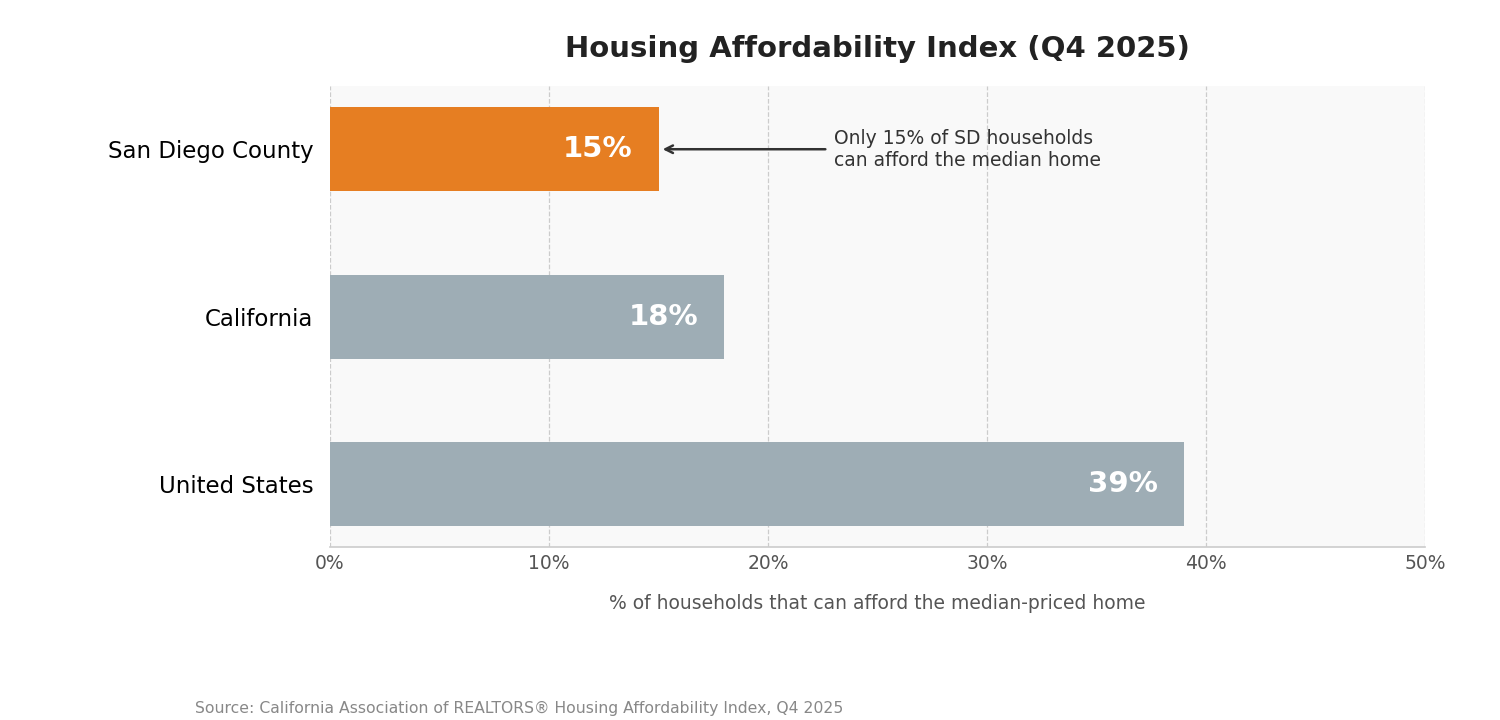
The California Association of REALTORS publishes a number called the Housing Affordability Index. It tells you what percentage of households in a county can actually afford to buy the median-priced home, based on income, interest rates, and required down payment.
In San Diego County, that number is 15.
That means only 15 out of every 100 households here can qualify to buy the median home. As of February 2026, that median price is $1,050,000. To qualify, you need a household income of at least $243,600 per year. Your monthly payment, including taxes and insurance, would be roughly $6,090.
Source: California Association of REALTORS® (C.A.R.), Q4 2025 | junipersdre.com
For comparison: the national average is 39%. California statewide is 18%. Even Orange County, with a $1.4 million median price, has a higher affordability index than San Diego at 14. Riverside County, one hour east, is at 24. The further inland you go, the more you get for your money.
This does not mean you cannot live here. It means you need a real plan. My guide to how much home you can afford in San Diego breaks down the math by price tier, including down payment programs that change the picture for first-time buyers.
2. Your utility bill is going to surprise you
SDG&E, San Diego Gas and Electric, has some of the highest electricity rates in the country. It catches nearly every newcomer off guard.
A typical two-bedroom apartment runs $150 to $250 per month on electricity in mild weather. A house with air conditioning running in summer can hit $400 to $600 or more. The rate structure is tiered, so every kilowatt-hour above your baseline costs more than the last one.
Gas adds another layer. California has the highest gas excise tax in the nation, about $0.59 per gallon in 2026. If you are in a home with gas appliances, budget an extra $80 to $120 per month on top of electricity.
Two things to do before you sign anything. Ask whether the property has solar. And ask to see the actual prior utility bills. Landlords in California are required to provide them. If there is no solar, use $200 per month as your floor, not your ceiling.
3. San Diego has microclimates, and they matter more than your zip code
The most upvoted piece of advice in a recent r/sandiego newcomers thread, with nearly 1,000 votes, was this:
“Microclimates and traffic patterns. The part of town you live in really affects your quality of life.”
That holds more than most newcomers expect.
The coast, from Pacific Beach through Ocean Beach and Point Loma, sits under a marine layer for much of spring and early summer. Mornings are in the mid-60s and gray. The fog usually burns off by 10am or noon. You will rarely need air conditioning. You will also rarely see full morning sun before July.
Five miles inland, in North Park, Hillcrest, or Kensington, the marine layer clears faster. You get more sun in the morning, hotter summers that can hit the low 90s, and almost no fog by mid-morning. Keep going east toward La Mesa or El Cajon, and summers get hot.
The local rule of thumb: east of the I-5, west of the I-15 is the sweet spot. You get proximity to the coast without the persistent morning gray.

Photo: Pexels
If you visit in May or June and find the beach overcast, that is June Gloom. It is real, it is seasonal, and by July it is gone. Do not judge the city by a spring visit to the water. Come back in multiple seasons before you decide where you want to live.
4. San Diego salaries run lower than LA and Orange County for the same roles
This one surprises people from the Bay Area and LA the most. San Diego has a strong economy, but the same job title at the same type of company typically pays 10 to 20 percent less than it does in LA or Orange County, and 25 to 40 percent less than the Bay Area.
The strongest industries here are the military and defense contractors, biotech and pharma near the Torrey Pines corridor, the three major hospital systems (UCSD Health, Scripps, and Sharp), and a growing tech sector in downtown and Sorrento Valley. If your career is in one of those fields, San Diego is a great market. If you are in finance, entertainment, or media, the opportunities are thinner.
If you are moving without a job lined up, give yourself three to four months of runway. San Diego employers tend to move slowly. Start applying before your move date, not after. The 2026 San Diego relocation guide covers the job market sector by sector.
5. A car is not optional, but your commute corridor is everything
San Diego’s public transit is decent if you happen to live near a trolley station and work near one too. Most people do not. The city is spread out, and most daily life is car-dependent.
The three interstates you need to know: The I-5 runs up the coast, from downtown through La Jolla to Orange County. The I-15 goes inland, through Miramar and up toward Escondido. The I-805 runs between them, through Clairemont and Sorrento Valley.
Traffic flows northbound and westbound in the morning. It reverses in the evening. Every weekday, without exception.
That pattern matters more than most people realize when picking where to live. A commute from Chula Vista to La Jolla fighting that flow can cost you 45 to 75 minutes each way on a bad day. If you can find a neighborhood that either skips the freeway or puts you driving against traffic, your mornings are a lot better.
6. Mello-Roos and HOA fees can add $500 to $1,200 per month to your housing cost
Mello-Roos is a special tax that applies to many California communities built after 1982. It funds local infrastructure like schools, fire stations, and roads. It gets collected through your property tax bill, and it does not appear anywhere on a Zillow listing.
In San Diego County, annual Mello-Roos assessments can run from $1,500 to $6,000 per year depending on the community. Before you make an offer on any property, ask one specific question: Does this home have a Mello-Roos assessment, and what is the annual amount? I ask it on behalf of every buyer I work with. The answer changes the true cost of ownership.
Then add HOA fees. A condo in Pacific Beach or Little Italy typically runs $400 to $700 per month in dues. Combined with Mello-Roos in a newer community, you could be adding $10,000 to $14,000 a year in costs that the listing price never showed you.
Sources: Redfin, SDG&E, BLS, Numbeo (2026) | junipersdre.com
7. The coast is not always sunny, especially in spring
San Diego gets more than 300 days of sunshine a year. That reputation is earned. But from roughly April through late June, the coastal neighborhoods operate under a different weather pattern, and it catches transplants off guard.
Low marine clouds roll in from the Pacific overnight and sit over the coast all morning. Temperatures hover in the upper 60s. The sky is a flat, bright gray. Most days the clouds burn off by noon and the afternoon is clear and warm. But mornings near the water can feel like Seattle for weeks at a stretch.
Locals call it June Gloom. The earlier versions are May Gray and April Showers. By July 4th, the marine layer is gone and San Diego becomes the city everyone imagines.
If you need morning sun every day, look at North Park, Kensington, or South Park. Those neighborhoods sit above the inversion layer and see the sun earlier. If you love cool, moody coastal mornings, Point Loma and Pacific Beach are gorgeous in that weather.
8. The neighborhood you pick is your entire San Diego experience
Your neighborhood pick is your entire San Diego experience. The weather you wake up to, your commute, how walkable your daily life is, your dining options, your price: none of it is fixed to the city. It is fixed to where you land. San Diego is not one city with variations. It is a collection of very different communities that happen to share a county line.
Urban and walkable: North Park and University Heights have dense blocks, walkable dining and coffee, and a strong neighborhood culture. Hillcrest adds proximity to Balboa Park. Little Italy is the most walkable neighborhood in the county, with a world-class restaurant row and easy access to downtown.
Beach lifestyle: Pacific Beach is casual, active, and younger. Point Loma is quieter and more established, with Liberty Station, Sunset Cliffs, and some of the fastest-selling homes in the county.
Family and suburban: Clairemont is 15 minutes from the beach with strong schools and tight inventory. La Mesa gives you a walkable village, great schools, and more space for the money. La Jolla has the best school ratings in the county and a price to match.
Character and value: Kensington, South Park, and Bankers Hill have historic homes, walkable streets, and prices that still have room to grow. Browse the full San Diego community guide collection for current market data on every neighborhood.
9. The food scene is one of the best surprises
Most people moving to San Diego expect good Mexican food. They are not prepared for how good it is, or for how much else is here.
Start with the Mexican food, because it is the real deal. San Diego sits 20 miles from Tijuana, and the culinary exchange across that border has been going on for more than a century. Baja-style fish tacos, carne asada burritos, birria, machaca breakfast burritos, and fresh aguachile are not novelties here. They are Tuesday lunch. Barrio Logan and the Mission District have some of the most authentic Mexican kitchens in the country. Locals who move away describe the Mexican food as the thing they miss most.
Beyond that, the city has serious depth. San Diego is home to one of the largest Vietnamese communities in California. The neighborhood known as Little Saigon runs along El Cajon Boulevard in City Heights, and it is the real thing. The pho shops, the banh mi counters, the Vietnamese sandwich spots and noodle houses are the kind of places food writers fly in to cover. Most people outside San Diego have never heard of it.
Then there is Convoy Street. It cuts through the Mira Mesa and Kensington corridor and is widely considered one of the best Asian dining strips on the entire West Coast. Japanese ramen, Taiwanese beef noodle soup, Korean BBQ, Hong Kong dim sum, Chinese hot pot. All of it in the same few blocks of strip malls that look completely unassuming from the outside. Locals know. Food writers from LA write about it reverently.
Little Italy delivers on its name. The India Street dining corridor has serious Italian cooking, a Saturday farmers market that draws the whole city, and a food hall that is packed every weekend. North Park has the independent restaurant scene, with new chefs opening constantly and a craft brewery corridor that has made San Diego one of the top beer cities in the country.
San Diego rewards people who eat across neighborhoods. It is one of the most exciting food cities on the West Coast, and most people outside California still have not caught on.
10. California’s tax and cost structure has hidden layers
Housing is the big number. But California adds several layers on top of housing that stack up fast, especially for people moving from states without an income tax.
California’s income tax is progressive and gets steep quickly. If you are a single earner making more than $66,295 per year, your marginal rate is already at 9.3%. On a $100,000 income, that means roughly $3,100 per year in state income tax above the first $66K, on top of your federal taxes. For a household moving from Texas or Florida, the difference can be $8,000 to $12,000 per year in take-home pay at the same gross salary.
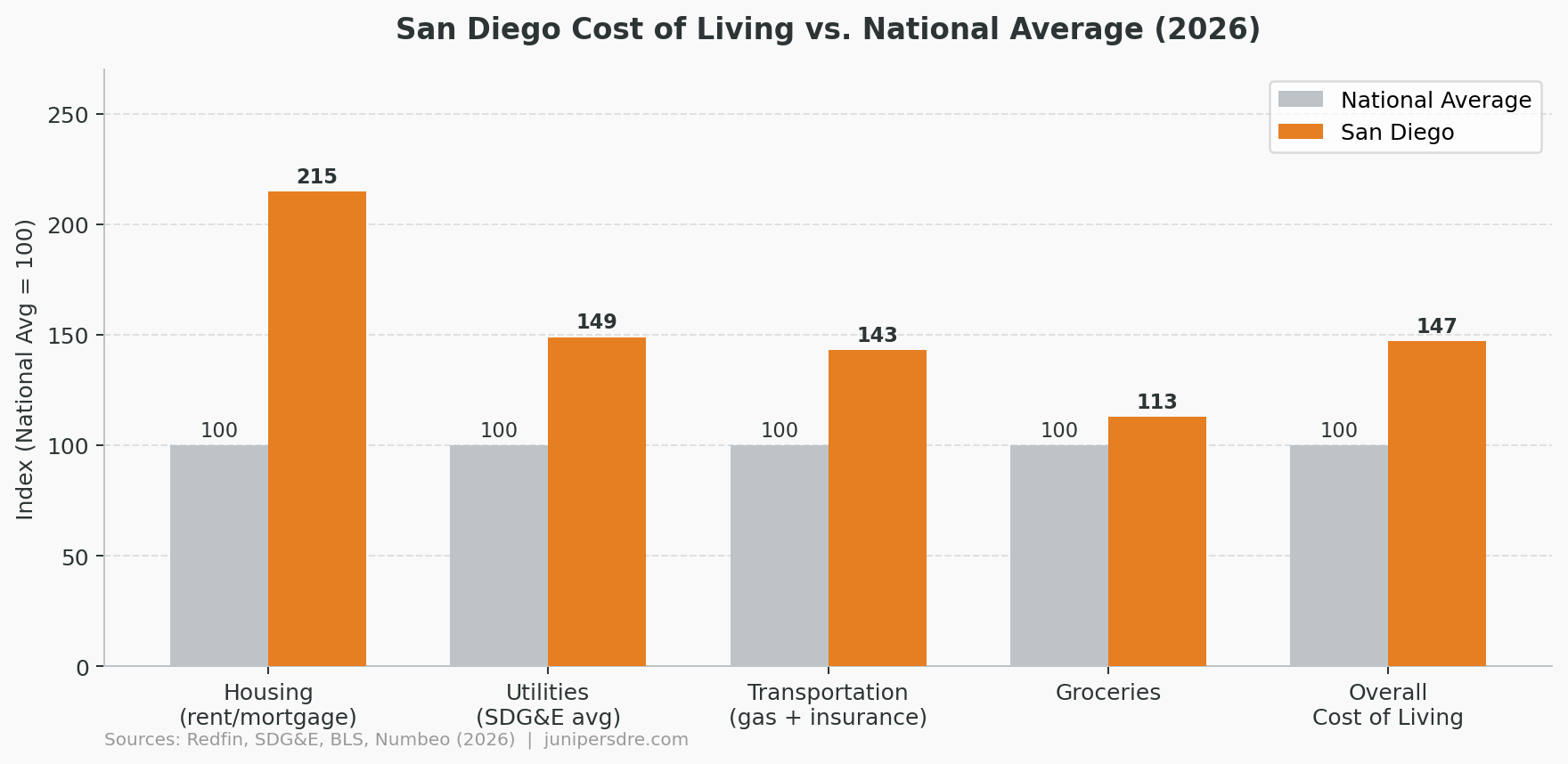
Car insurance is higher here than in most states. Budget 20 to 30 percent more than what you paid before. Gas costs more due to California’s excise tax, which is the highest in the nation. Water bills carry drought surcharges most years. Groceries run about 13 percent above the national average. Dining out runs 15 to 20 percent more.
Add all of it up, and San Diego’s overall cost of living is roughly 47 percent above the national average. Housing drives the most of it, but none of the other costs are rounding errors.
11. What $100K, $130K, and $150K actually look like here
These are the two most common questions I get from people researching a San Diego move.
At $100,000 per year as a single person, you can live here comfortably as a renter. A one-bedroom in North Park, Clairemont, or University Heights runs $1,800 to $2,300 per month. After taxes, rent, utilities, and food, you will have room to save, but not a large cushion. Buying on that income alone is difficult right now.
At $130,000 as a single person, you are in a solid position. You can rent a nicer place, build savings more aggressively, and start looking seriously at entry-level condos in the $550,000 to $700,000 range within a few years.
At $150,000 combined for a couple, homeownership becomes a realistic near-term goal in several neighborhoods. It takes discipline, but it is doable. Many of the families I have helped buy in Clairemont, La Mesa, and South Park over the past few years were right in that range. The full affordability breakdown maps qualifying income by price tier so you can see exactly where you land.
12. Come in prepared
The buyers who struggle here are almost always the ones who moved on feeling alone. They visited in August, fell in love with the weather, picked a neighborhood because the name sounded right, and then showed up to an SDG&E bill and a 45-minute commute they never planned for.
San Diego did not surprise them. They just did not prepare.
The buyers who do well arrive with a plan. They know their freeway corridor. They have driven their future commute at 8am on a Tuesday. They have asked about Mello-Roos. They know what June Gloom is before it shows up. They have three months of savings ready before move day, not three weeks.
My advice to anyone seriously thinking about this move: visit in May or June first, specifically to see the coastal weather at its most understated. Drive the commute. Walk the neighborhood on a weekday. That is the city you are signing up for.
The city is worth it. The outdoor access, the weather from July through October, the food, the pace: none of it is hype. San Diego delivers. It just works better when you understand what you are getting into.
What This Means for You
If you are planning to buy: Start with the affordability numbers. You need $243,600 in household income to qualify for the median home. Know where you stand before you start looking, ask about Mello-Roos on every property, and look into the down payment assistance programs available to San Diego County buyers. Those programs change the math more than most people expect.
If you are renting first: Pick your neighborhood before you pick your apartment. The microclimate you wake up in and the commute you drive every morning matter more to daily life than square footage or finishes. Get those right first, then find the unit.
If you are investing: A 15% affordability index means most San Diego households will be renters for a long time. Demand in strong school districts and transit-adjacent neighborhoods is not going away. The community guides include current market data for each area.
San Diego works well if you understand what you are walking into. Whether you are planning to buy or still figuring out which neighborhood fits your life, I am happy to answer specific questions about price ranges, commute corridors, or whether the timing makes sense for your situation.
Miguel Chairez, Juniper Real Estate Co.
619.253.3333 | miguel(at)junipersdre(dotted)com
Contact Miguel | Browse Neighborhoods | Buyer Services
Data sources: California Association of REALTORS® Housing Affordability Index Q4 2025; Redfin 2026 Cost of Living Index; Bureau of Labor Statistics CPI San Diego March 2026; SDG&E rate schedules 2026; California Board of Equalization gas tax data.
Frequently Asked Questions
What should I know before moving to San Diego?
The most important things to know are the high cost of housing (only 15% of households can afford the median home), the SDG&E utility rates, how much microclimates affect your daily life, how car-dependent most of the city is, and the hidden costs like Mello-Roos and HOA fees that do not show up on a listing. San Diego is a great place to live. It just rewards people who plan ahead.
Is $100,000 enough to live in San Diego?
Yes, for a single person renting. A one-bedroom in most mid-city neighborhoods runs $1,800 to $2,300 per month. At $100,000 in income you can cover your bills and save some money, but buying on that income alone is a long road. A couple earning a combined $100,000 will need to budget carefully, especially near the coast where rents are higher.
Is $130,000 a good salary in San Diego?
Yes. At $130,000 as a single person you can rent comfortably in most neighborhoods, save at a solid rate, and realistically work toward buying an entry-level condo within a few years. For two people earning a combined $130,000, life is comfortable but buying will take time and discipline.
What is the downside of living in San Diego?
The main downsides are the high cost of housing, the SDG&E utility bills, heavy freeway traffic on the I-5, I-15, and I-805 during commute hours, the car-dependent layout of most neighborhoods, and California’s income tax hitting people from no-tax states hard. Most residents will tell you the tradeoff is worth it, but those costs are real.
What are the “four corners of death” in San Diego?
The “four corners of death” is a local nickname, used informally and not always consistently, for a handful of notoriously congested or accident-prone intersections. The term shows up most in neighborhood forums, often pointing to busy surface street intersections in different parts of the county. It is more of a local running joke than a formal designation. Ask any longtime San Diego driver and they will have their own candidate for the title.